WHY I BUILT KINVA
AI should help you hear yourself think.
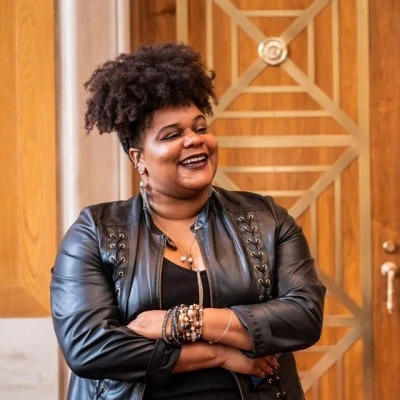
I’m Alexandria Glaize, founder of Kinva.
I’ve spent my career asking some version of the same question: how do you create the conditions for people to learn, unlearn, and hear themselves more clearly — and how do you make those conditions available to more people?
That question took me through AmeriCorps and the Peace Corps, civil rights and inclusion work, mentorship at scale, and mental health marketing. The settings changed. The underlying lesson did not.
AmeriCorps & Peace Corps
Service, up close.
Civil rights & inclusion
Who gets access, and who doesn’t.
Mentorship at scale
The right match changes the outcome.
Mental health
Meeting people where they already are.
KINVA
Those lessons, applied to how people think.
People do better when support meets them as they are. And the right kind of support matters more than simply having support available.
Understanding needs more than language.
For about four years I participated in Emotional Emancipation Circles, a framework developed by the Association of Black Psychologists and the Community Healing Network for Black communities to examine and unlearn the messages we’ve inherited about ourselves. I went through the facilitator training as well.
One of the things that stayed with me is the structure around it. Language for something I had lived but never named. A framework that didn’t start from dominant-culture assumptions. People whose experiences overlapped with mine closely enough that hearing theirs let me recognize my own. Questions that pushed on things I had stopped examining years ago.
Nobody handed me a conclusion. The conditions made it possible to arrive at one.
I’ve found versions of that in other places — mentorship, therapy, community conversations, sitting with elders, friendship. Different practices doing different work. But they taught me the same thing, and I carry it into what I build.
Understanding is something a person arrives at. The conditions around them determine whether they can.
Having a thought is not the same as understanding it.
A decision can make sense on paper and still not feel settled. An idea can be promising before it has shape. A conversation can matter before you know what you want to say. Sometimes the answer isn’t missing. The thought just isn’t finished.
Kinva is the investigation in between.
01
Technology should strengthen our judgment.
People are already bringing deeply human questions to AI. Decisions. Relationships. Work. Identity. The thoughts they once took to a friend, a notebook, or nowhere at all.
I was doing it too.
AI helped me find language, see patterns, and move through things faster. It gave me language the way those rooms had. But the language arrived alone. No framework asking me to test it. Nobody there to say that isn’t quite it. No time.
I noticed how easy it was to accept the first polished answer and mistake it for my own conclusion.
The tool was thinking efficiently. I was participating less.
I don’t believe the answer is to stop using AI. I believe we need to design AI that keeps the person engaged in their own thinking.
02
Different minds need different first moves.
Some people find clarity by organizing the pieces. Some need to explore before they decide. Some need a useful challenge, a wider perspective, momentum, emotional precision, or somewhere steady to begin.
Giving every person the same conversational experience is not personalization.
At Mentor Collective, I saw what changed when people were matched with the right kind of support. In mental health, I saw the importance of meeting people where they already were.
Kinva carries those lessons into a different kind of product: a thought partner matched to how you process.
Kinva is an expression of these beliefs
Kinva matches you with one of seven AI thought partners, each designed around a different cognitive and conversational approach.
Matched thinking
Seven distinct cognitive approaches.
Designed conversation
Attune, unfold, deepen, recede.
Natural completion
Clarity matters more than continued engagement.
Kinva is nonclinical. It is not therapy, diagnosis, crisis care, or a replacement for human support. It is a place for the everyday thinking that still deserves somewhere to go.
Find my thought partner03
Clarity should still belong to you.
A convincing answer is not the same thing as understanding.
Kinva is designed to ask, reflect, structure, and challenge without becoming the authority on your life. It can help you examine what you think. It should not decide what is true for you.
The goal is clarity you recognize as your own.
04
Good technology should know when to recede.
Most technology is designed to keep us engaged. Kinva is not.
A thought partner should not manufacture intimacy, encourage dependency, or keep a conversation going after it has done its work. When you have reached what you came for, the conversation should be allowed to end.
That natural ending is part of the product.
I built it with people close to me.
I didn’t begin with a plan to build a company. The first version was for my mom, my sister, my brother, and the people beside me.
Building it with them changed what I thought Kinva needed to be. The earliest version leaned toward comfort. What people actually brought were decisions, relationships, ideas, and things they were still trying to understand. Their feedback moved Kinva toward what it is now.
That loop hasn’t stopped. The people using Kinva surface assumptions I can’t see on my own, test how the system responds across different identities and ways of processing, and shape what gets built next.
The underlying models already existed. What was missing was a system designed to provide that benefit on purpose.
Kinva started in community. I want it to keep being built that way.
That is what I’m building: a place where technology does not become your inner authority. It helps you stay in conversation with yourself.
The place you go to think.
— Alexandria Glaize
Founder and CEO, KINVA